


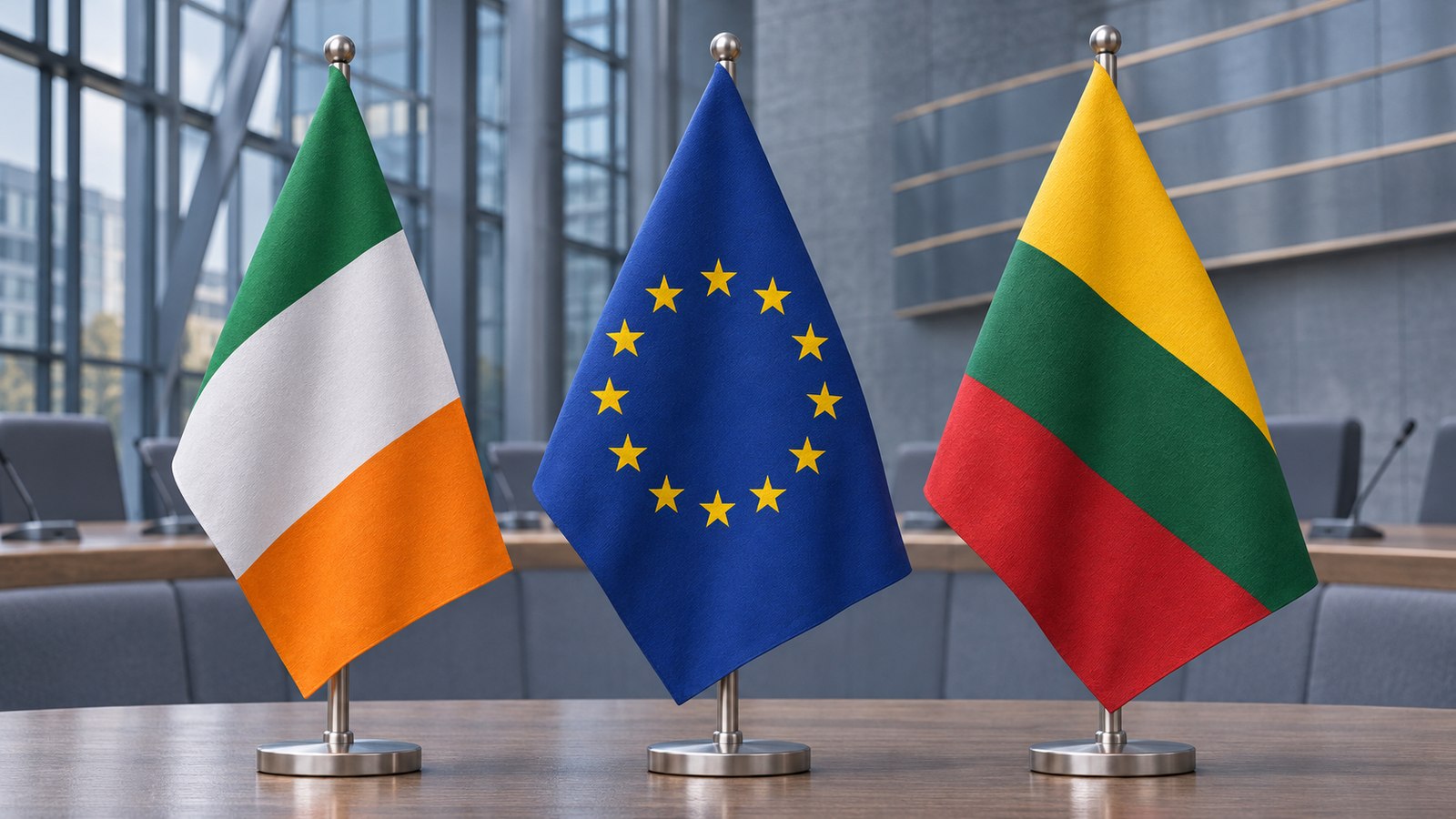
Lithuania takes over the EU Council presidency after Ireland on 1 January 2027 and holds it until 30 June 2027. Greece follows on 1 July 2027. The handover changes which country chairs most Council meetings and leads negotiations on behalf of member states. EU proposals already under discussion can continue under the new presidency. Council of the EU presidency calendar Consilium
Who holds the EU Council presidency after Ireland?
Ireland, Lithuania and Greece form a presidency trio. Each country chairs the Council for six months. The trio agrees on a common programme for the full 18 months, and each country prepares a more detailed plan for its own term. Council of the EU guide to presidency trios Consilium
| Country | Presidency dates |
|---|---|
| Ireland | 1 July to 31 December 2026 |
| Lithuania | 1 January to 30 June 2027 |
| Greece | 1 July to 31 December 2027 |
For background on the work Ireland has been leading, see Ireland’s EU Presidency 2026: Key Impacts.
What changes when Lithuania takes over?
Lithuanian ministers and officials will chair most Council meetings and help member states work towards common positions. The presidency also represents the Council in negotiations with the European Parliament. One important exception is the Foreign Affairs Council, which is chaired by the EU’s High Representative for Foreign Affairs and Security Policy. Council of the EU guide to the rotating presidency Consilium
Ireland continues to take part in Council discussions as an EU member state. For people following a particular proposal, the question in January is where negotiations left off in December. A proposal still being discussed by national governments is at a different stage from one where the Council and Parliament have already reached a provisional deal. What the Council of the EU does Consilium
How to follow an EU proposal through the handover
Start by finding the proposal’s official name. Look for the most recent Council update and note whether it describes a Council position, a provisional agreement with Parliament or formal adoption. Those terms tell you how far the proposal has moved.
| What the update says | What it means |
|---|---|
| Council agrees its position | Member states have agreed on the Council’s approach. Where Parliament is a co-legislator, negotiations may still be ahead. |
| Council and Parliament reach a provisional agreement | Negotiators have agreed on a text that still needs formal approval. |
| The legislation is formally adopted | Check the published text for when it enters into force and when its rules start to apply. |
For example, if you run an Irish business and see that ministers have reached a Council position on a proposal in December, use that update as your starting point when Lithuania takes over. The next milestone may be negotiations with Parliament. Once a law is adopted, its application date is the one to check when planning changes to your business. Council of the EU legislative overview Consilium
Frequently asked questions
When does Ireland’s EU Council presidency end?
Ireland’s term ends on 31 December 2026. Lithuania takes over on 1 January 2027 for six months. Official presidency schedule European Commission
Is the EU Council presidency the same as the European Council presidency?
They are separate roles. The rotating presidency chairs most meetings of the Council of the European Union, where national ministers meet. The European Council brings together EU leaders and has its own president. Council of the EU and European Council Consilium
Who takes over after Lithuania?
Greece takes over on 1 July 2027 and holds the presidency until 31 December 2027, completing the trio that began with Ireland. Official presidency schedule
