


Published: 2 September 2026
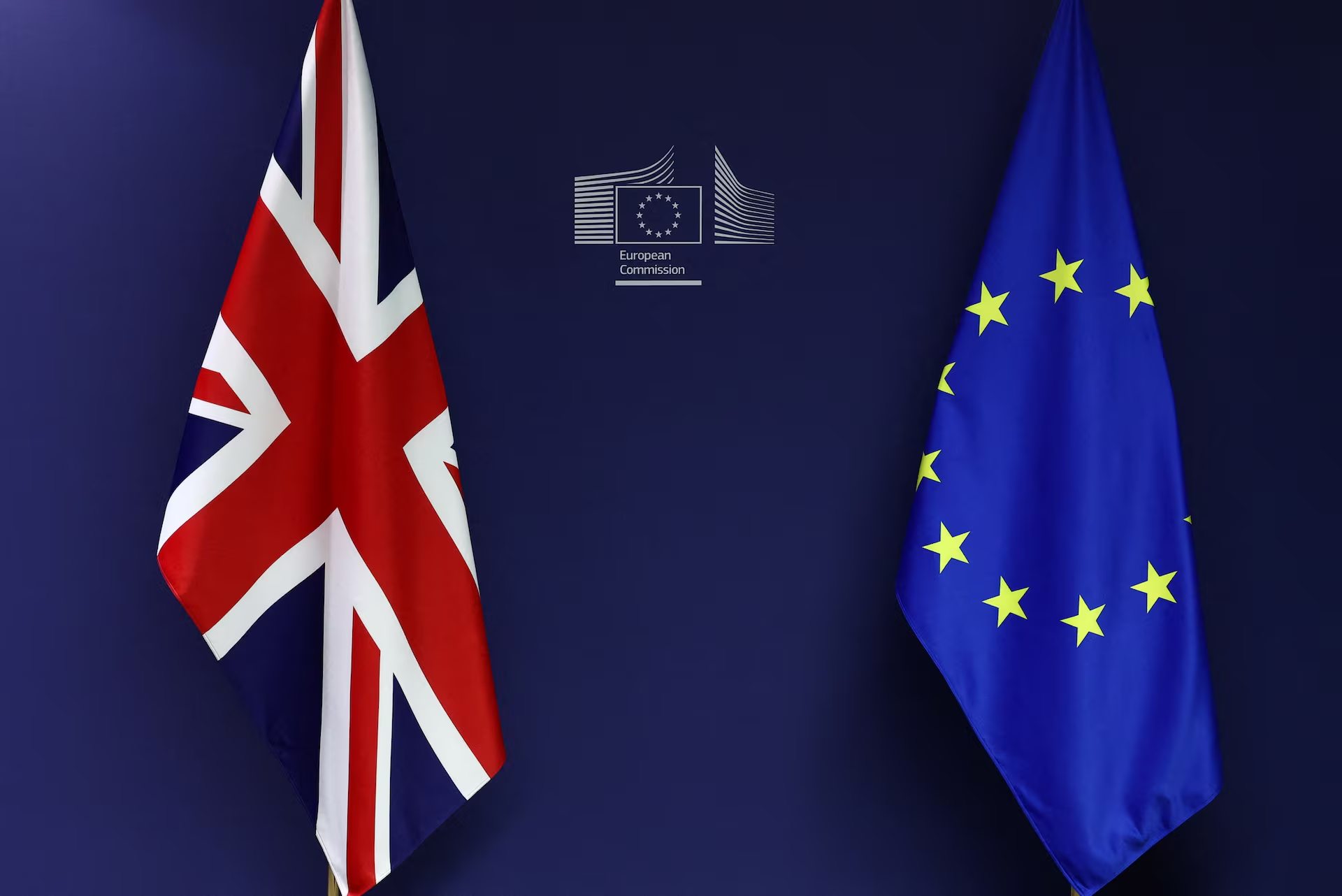
The United Kingdom and European Union are moving towards a closer relationship across defence, trade, energy, regulation, education and youth mobility. The shift does not mean Britain is seeking to rejoin the EU or its Single Market. Instead, both sides are pursuing targeted agreements designed to reduce friction, strengthen security and create more practical cooperation while retaining separate decision-making systems.
What is happening between the UK and EU?
The UK-EU relationship is entering a more pragmatic phase.
The first major step came at the UK-EU Summit in London on 19 May 2025, when both sides agreed a new Strategic Partnership. The agreement built on the existing Withdrawal Agreement and Trade and Cooperation Agreement while opening negotiations in areas including security, energy, emissions trading, food standards, youth mobility and education.
Since then, cooperation has continued through formal negotiations and institutional meetings.
The February 2026 meeting of the UK-EU Trade and Cooperation Agreement Partnership Council recorded progress on Erasmus+, competition cooperation, fisheries and energy. It also identified the proposed sanitary and phytosanitary agreement, emissions-trading link and Youth Experience Scheme as areas where negotiations were intended to advance.
The political momentum has continued despite the postponement of the summit originally planned for 22 July.
On 20 July, Burnham and Commission President Ursula von der Leyen agreed that their teams should work towards a summit later in 2026. On 24 August, Burnham and European Council President António Costa again called for a more ambitious relationship and said a future summit would provide an opportunity to advance that work.
Why are Britain and the EU seeking closer cooperation?
The basic reason is geography and shared interests.
Britain remains closely connected to the European economy and security environment despite leaving the EU.
The two sides also face common challenges. These include Russia’s war against Ukraine, European defence, energy security, irregular migration, organised crime, climate policy and the competitiveness of European industries.
The 2025 Security and Defence Partnership established a framework for cooperation on Ukraine, maritime security, space security, hybrid threats, critical infrastructure and defence-industry cooperation.
The new approach is therefore less about reversing Brexit and more about addressing practical problems that are difficult for either side to manage alone.
Defence and security are at the centre of the relationship
Security has become one of the strongest areas of UK-EU cooperation.
The Security and Defence Partnership agreed in May 2025 provides for regular exchanges on regional security, cooperation supporting Ukraine, sanctions and collaboration across areas including maritime security, space, critical infrastructure and hybrid threats.
Defence cooperation also has an economic dimension.
The UK and EU have discussed opportunities for cooperation and joint investment in their defence industrial bases. The UK government has linked this to European defence initiatives, including opportunities associated with the EU’s SAFE instrument.
For Britain, the potential benefit extends beyond military coordination. Greater industrial cooperation could create opportunities for UK defence manufacturers, technology companies and suppliers.
This matters at a time when European countries are increasing defence spending and trying to expand industrial capacity.
Trade remains the biggest practical test
Security cooperation has moved relatively quickly. Trade is more complicated.
The Trade and Cooperation Agreement continues to govern the central economic relationship between Britain and the EU. It provides zero tariffs and zero quotas for goods that meet the relevant rules-of-origin requirements, but it does not recreate the frictionless trading conditions that existed when Britain was inside the Single Market and Customs Union.
The result is a relationship in which trade remains substantial but businesses must manage customs procedures, regulatory requirements and other non-tariff barriers.
That is why the current cooperation agenda is focused on specific problems rather than attempting to recreate the pre-Brexit system.
The proposed SPS agreement
One of the most important negotiations concerns sanitary and phytosanitary, or SPS, rules.
The proposed agreement covers areas including plants, animals, food and feed safety and wider agri-food regulation. The UK government says it intends the arrangements to take effect in mid-2027, although negotiations and implementation procedures remain important steps before that can happen.
For UK food producers, farmers, exporters and logistics companies, this could be one of the most commercially significant elements of the closer relationship.
The objective is to reduce some of the certification, inspection and administrative friction associated with moving agri-food products between Britain and the EU.
It would not mean the UK simply becomes an EU member or automatically adopts every EU rule.
Carbon markets could become more closely connected
Climate policy is another important area.
The UK and EU agreed in 2025 to work towards linking their emissions trading systems.
The UK ETS and EU ETS currently operate as separate carbon markets. Linking them could create a larger carbon market and reduce some of the competitive distortions caused by having separate systems.
The UK government says negotiations are under way and that the two sides had aimed to conclude the work around the next UK-EU summit.
For British industrial companies exporting to Europe, the issue has a direct commercial dimension.
A more closely connected carbon-pricing framework could affect compliance costs, competitiveness and the treatment of carbon-intensive goods moving across the Channel.
Energy cooperation could become more important
Energy is another area where physical geography makes cooperation particularly relevant.
Britain and continental Europe remain connected through electricity interconnectors, while the North Sea is becoming increasingly important for offshore wind and wider energy infrastructure.
The UK-EU relationship has already moved towards continued energy cooperation. The 2026 Partnership Council also recorded the conclusion of exploratory talks concerning UK participation in the EU’s internal electricity market and agreed to proceed according to the relevant legal frameworks.
Closer energy cooperation could matter for:
- electricity trading;
- renewable-energy investment;
- offshore wind;
- energy security;
- cross-border infrastructure;
- market stability.
For UK households and businesses, the significance is ultimately linked to energy security and the cost and reliability of electricity.
Education is one of the clearest areas of progress
The education relationship has produced a concrete result.
In April 2026, Britain and the EU formally agreed the legal text for UK association with Erasmus+ from 2027. The UK government expects more than 100,000 people to benefit in the programme’s first year, including students, apprentices and young people.
This is significant because Erasmus+ is one of the most visible examples of practical post-Brexit cooperation.
The agreement could give UK students and young people more opportunities for study, training, placements and exchanges across Europe.
It also demonstrates the broader character of the current UK-EU reset: cooperation is being rebuilt selectively in areas where both sides see practical value.
Youth mobility remains a separate issue
Erasmus+ should not be confused with a broader UK-EU youth mobility agreement.
The 2025 summit established an intention to work towards a Youth Experience Scheme. The proposed arrangement would be time-limited and subject to mutually agreed terms, including a participant limit. The UK government has also said that the scheme should operate within specific domestic parameters, including restrictions on access to benefits and dependants.
The distinction matters.
Erasmus+ is primarily an education and training programme.
A Youth Experience Scheme would address the wider ability of young people to spend time in another country for work, cultural experience or study.
For young British people who lost access to automatic free movement after Brexit, the difference could be substantial.
Competition policy is another area of institutional cooperation
The UK and EU have also moved towards closer cooperation between competition authorities.
An agreement on cooperation in the application of their respective competition laws was presented to the UK Parliament in April 2026.
This matters because major companies increasingly operate across multiple jurisdictions.
Closer cooperation between competition authorities can make it easier for regulators to exchange relevant information and coordinate enforcement where business activity crosses borders.
It is a technical area, but one with potentially important consequences for large companies and markets.
Fisheries show that cooperation can also involve difficult compromises
Fishing remains politically sensitive.
The UK and EU agreed arrangements providing reciprocal access to waters through 30 June 2038. The two sides also continue annual consultations and quota transfers concerning jointly managed fish stocks.
The fisheries relationship illustrates an important feature of the wider UK-EU reset.
Closer cooperation does not mean every dispute disappears.
Instead, governments are trying to establish longer-term frameworks in areas where both sides have economic and environmental interests.
Gibraltar has become another significant part of the relationship
The UK and EU signed an agreement concerning Gibraltar on 14 July 2026.
The agreement is intended to provide greater certainty for Gibraltar’s people and economy while addressing the territory’s relationship with the EU and Spain. The UK government published the treaty and supporting documents on 14 July.
Gibraltar is therefore another example of the broader trend: specific bilateral arrangements are being developed where both sides see a practical need for cooperation.
What does closer UK-EU cooperation mean for British businesses?
For UK companies, the most important question is whether cooperation reduces the cost and complexity of doing business with Europe.
The answer will vary considerably by sector.
Food and agriculture
The SPS negotiations could eventually reduce some border friction and certification requirements.
Manufacturing
Closer cooperation on carbon markets and technical rules could affect manufacturers exposed to European environmental and regulatory requirements.
Defence
British defence companies could benefit from greater cooperation with European partners and participation in selected European defence initiatives.
Energy
Energy companies may benefit from closer electricity and carbon-market cooperation.
Technology
Research and innovation cooperation could provide opportunities for British technology companies and universities.
Services
Services remain more complicated because the TCA does not recreate the comprehensive market-access arrangements that existed before Brexit.
The broader lesson is that closer cooperation is likely to produce sector-specific benefits rather than a single dramatic change to the UK’s trading relationship with Europe.
What does it mean for UK consumers?
The effects on consumers are less immediate but could still be significant.
If future agreements reduce trade friction, businesses could potentially face lower administrative costs when moving certain goods across borders.
Energy cooperation could influence the operation of interconnected electricity markets.
Education and youth agreements could expand opportunities for younger people.
But consumers should not assume that closer UK-EU relations mean a return to pre-Brexit free movement or unrestricted access to the EU Single Market.
The government’s current approach remains based on targeted cooperation.
The Ireland angle
Ireland has an unusually important position in the UK-EU relationship because it is both an EU member state and Britain’s closest neighbouring EU country.
Ireland also holds the rotating Presidency of the Council of the EU from 1 July to 31 December 2026. During that period, Irish ministers chair Council meetings and help steer the EU’s legislative and policy agenda.
That gives Dublin an important institutional role during a period in which UK-EU relations are being renegotiated in several practical areas.
The Ireland-UK relationship is particularly relevant to the SPS negotiations, Northern Ireland, energy, security and cross-border economic activity.
For Ireland, therefore, closer UK-EU cooperation is not simply a Brussels-London issue. Developments can have direct consequences for businesses and communities on the island of Ireland.
What happens next?
The next major political milestone is the UK-EU summit now being worked towards for later in 2026.
The timing matters because several negotiations were originally expected to progress towards the summit.
These include:
- the SPS agreement;
- UK-EU ETS linking;
- the Youth Experience Scheme;
- wider trade and economic cooperation;
- security and defence;
- energy;
- implementation of existing agreements.
The summit could therefore become an important test of whether the political reset produces tangible agreements.
But expectations should remain measured.
The UK remains outside the EU.
It is not returning to the Single Market or Customs Union as part of this cooperation agenda.
The more realistic question is whether Britain and the EU can remove selected barriers while maintaining regulatory autonomy.
A closer relationship, but not a return to the old one
The emerging UK-EU relationship is best understood as practical rapprochement rather than reversal of Brexit.
Britain and the EU are finding areas where cooperation makes economic, security or political sense.
Some changes are already concrete, such as the Erasmus+ agreement for 2027, the competition cooperation agreement and the Gibraltar treaty. Other areas, including SPS, emissions trading and youth mobility, remain subject to negotiations and implementation.
That makes the next stage particularly important.
The question is no longer simply whether London and Brussels want better relations. The more consequential question is how far that political ambition can be translated into agreements that businesses, workers, students and consumers can actually use.
Key Facts
| Issue | Current position |
|---|---|
| Strategic relationship | UK and EU agreed a Strategic Partnership in May 2025 |
| Next summit | Being worked towards for later in 2026 |
| Defence | Security and Defence Partnership already established |
| Erasmus+ | UK association agreed for 2027 |
| SPS | Negotiations continuing |
| ETS | Negotiations to link UK and EU carbon markets |
| Youth mobility | Youth Experience Scheme under negotiation |
| Competition | Cooperation agreement concluded |
| Fisheries | Reciprocal access arrangements extended to June 2038 |
| Ireland | EU Council Presidency from July–December 2026 |
| Gibraltar | UK-EU agreement signed July 2026 |
Sources: UK Government, European institutions and Irish Government.
UK Impact
The biggest potential UK benefits are likely to come from reducing specific barriers rather than changing Britain’s fundamental post-Brexit position.
Businesses could benefit from easier agri-food trade, closer carbon-market arrangements and improved cooperation with European regulators.
Students and apprentices will gain new opportunities through Erasmus+ from 2027.
Defence and technology companies could benefit from greater European industrial cooperation.
At the same time, businesses will continue to operate in a relationship shaped by separate UK and EU legal systems.
EU Impact
The EU also has practical reasons to improve relations with Britain.
The UK remains a major European economy and a significant defence power.
Closer cooperation can strengthen European security, improve coordination on Ukraine and support defence-industrial capacity.
It can also reduce friction for European companies trading with British customers and suppliers.
The relationship is therefore not simply about concessions to London. Brussels also has interests in making the relationship more predictable and functional.
Timeline
19 May 2025 — UK-EU Summit
The UK and EU agreed a new Strategic Partnership and announced cooperation across security, energy, trade, youth mobility and other areas.
February 2026 — TCA Partnership Council
The UK and EU recorded progress on Erasmus+, competition, fisheries and energy and continued work on SPS, ETS and youth mobility.
15 April 2026 — Erasmus+ agreement
The UK and EU finalised the legal text for UK association with Erasmus+ from 2027.
14 July 2026 — Gibraltar agreement
The UK and EU signed the agreement concerning Gibraltar.
20 July 2026 — Summit preparations
Burnham and von der Leyen agreed that their teams should work towards a UK-EU summit later in the year.
24 August 2026 — Renewed political push
Burnham and António Costa called for a more ambitious UK-EU relationship and pointed towards a future summit.
Key Takeaways
- The UK and EU are moving towards closer practical cooperation.
- This is not a plan for Britain to rejoin the EU.
- Defence and security are among the strongest areas of cooperation.
- Trade negotiations are focused on reducing specific post-Brexit barriers.
- The UK has agreed to join Erasmus+ from 2027.
- SPS, ETS and youth mobility remain important areas of negotiation.
- Ireland’s EU Presidency gives Dublin an important role during the second half of 2026.
- The next UK-EU summit will be an important test of whether political commitments produce further practical agreements.
Conclusion
The UK and EU are clearly attempting to build a more functional relationship in 2026. Defence, trade, energy, carbon markets, education, competition and youth mobility are all becoming part of a wider programme of selective cooperation.
The change is significant, but it should not be overstated. Britain remains outside the European Union, Single Market and Customs Union, and both sides continue to protect their decision-making autonomy.
The real measure of the reset will be practical: whether future agreements make it easier for British and European businesses to trade, researchers and students to collaborate, and both sides to respond collectively to shared security and economic challenges.
FAQ
1. Why are the UK and EU seeking closer cooperation?
The UK and EU share economic, security, energy and geographical interests. Both sides are therefore seeking targeted cooperation in areas where joint action can deliver practical benefits without reversing Brexit.
2. Is the UK planning to rejoin the European Union?
The current cooperation programme is not a plan for the UK to rejoin the EU. It focuses on specific agreements while preserving separate UK and EU decision-making systems.
3. What areas are the UK and EU cooperating on?
Major areas include defence, Ukraine, trade, food and agricultural standards, energy, emissions trading, education, youth mobility, competition policy and fisheries.
4. When is the next UK-EU summit?
The summit originally planned for 22 July 2026 was postponed. The UK and EU are now working towards a summit later in 2026.
5. Will UK students be able to use Erasmus+ again?
Yes. The UK and EU finalised the legal text for UK association with Erasmus+ from 2027. The UK government expects more than 100,000 people to benefit in the programme’s first year.
6. What is the UK-EU SPS agreement?
It is a proposed agreement covering sanitary and phytosanitary rules affecting plants, animals, food and related products. The UK government intends the arrangements to take effect in mid-2027, subject to the necessary negotiations and procedures.
7. Are Britain and the EU linking their carbon markets?
They are negotiating towards a link between the UK Emissions Trading Scheme and the EU Emissions Trading System.
8. How does closer UK-EU cooperation affect businesses?
The potential effects vary by sector. Food exporters could benefit from reduced SPS friction, manufacturers could be affected by carbon-market arrangements, and defence and technology companies could gain from greater European cooperation.
9. What role does Ireland play?
Ireland holds the Presidency of the Council of the EU from 1 July to 31 December 2026. This gives Ireland an important institutional role in coordinating Council work during a period of renewed UK-EU engagement.
10. Does closer cooperation mean the UK will return to the EU Single Market?
No. The current programme is based on targeted cooperation rather than re-entry into the Single Market or Customs Union.
